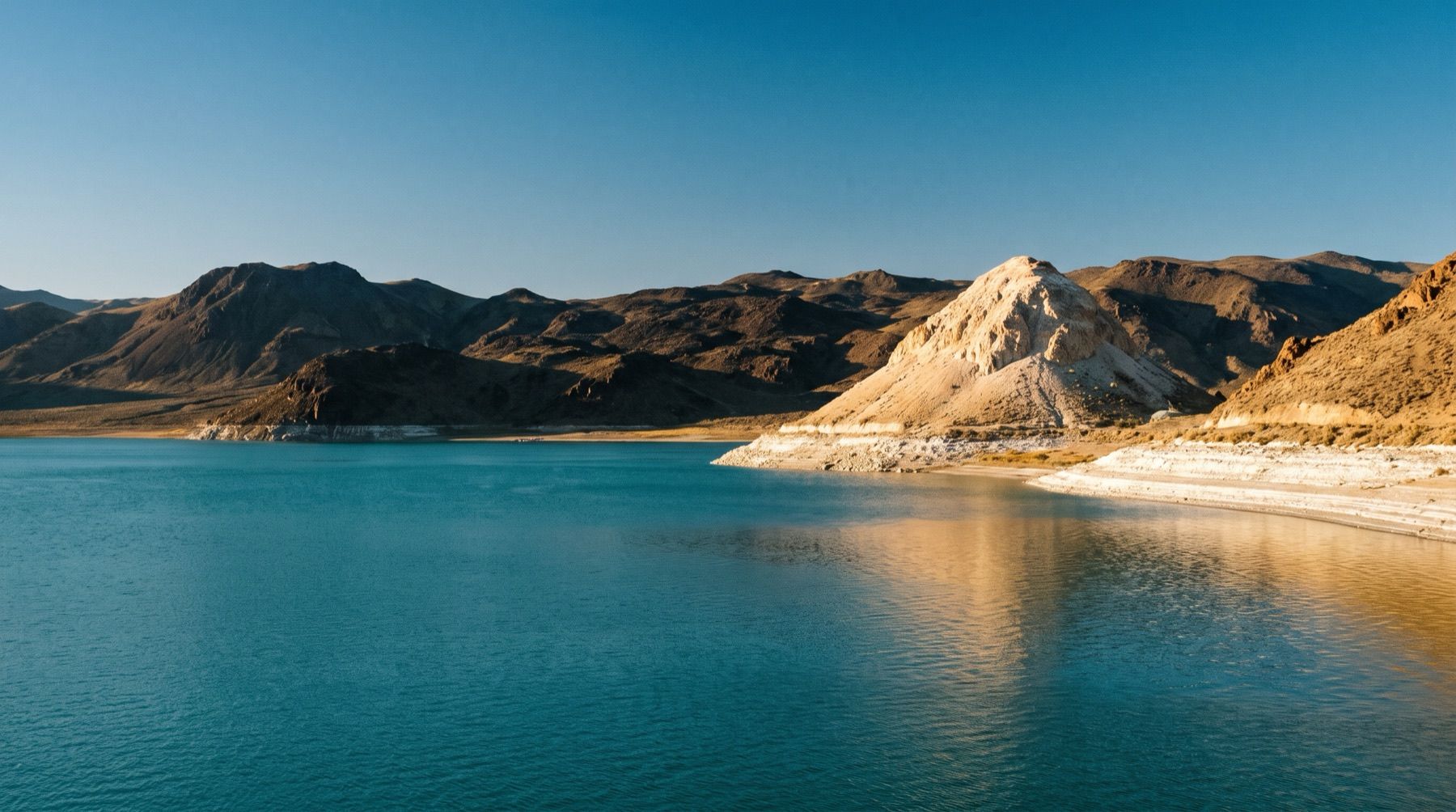
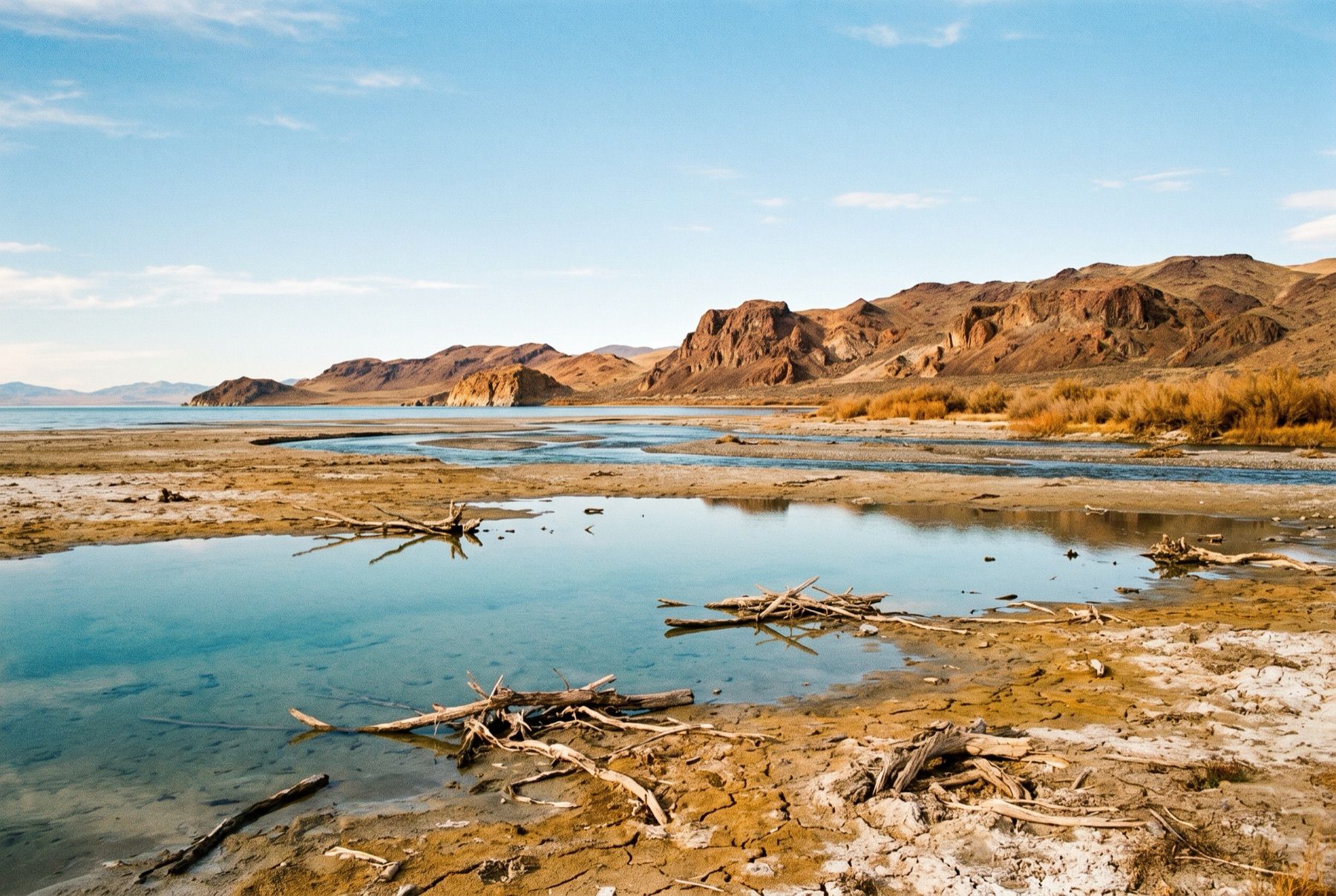
Pyramid Lake is a desert water body 35 miles from Reno in a straight line. It is the deepest surviving remnant of prehistoric Lake Lahontan, an inland sea that covered much of western Nevada during the ice age.
At its highstand 15,000 years ago, Lake Lahontan reached a depth of 281 meters in the Pyramid Lake subbasin. Today the water sits 106 meters deep, surrounded by pale calcium carbonate towers that rise out of the sagebrush and shore.
The Calcium Skeleton of Lake Lahontan
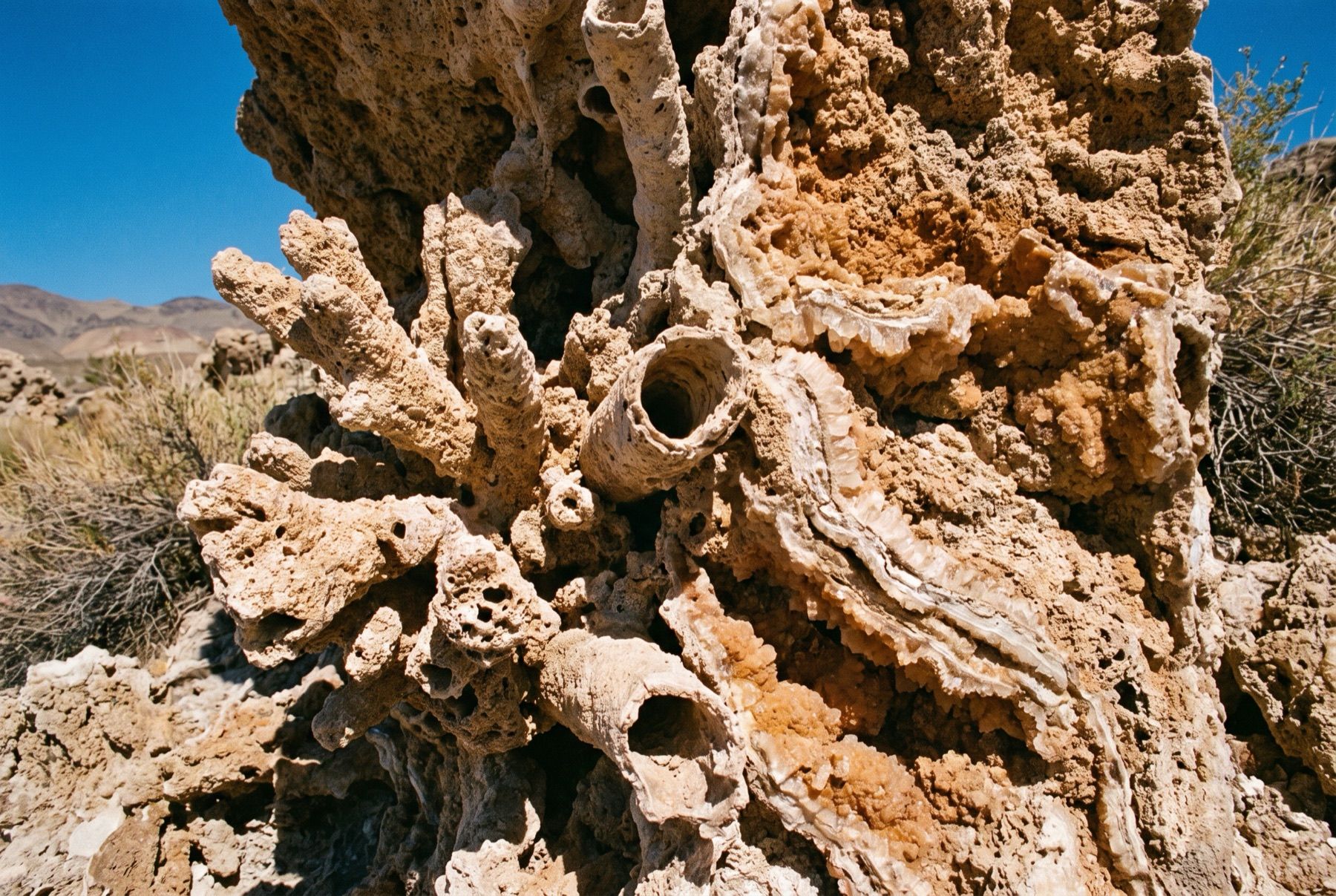
Between 26,000 and 13,000 years ago, sublacustrine springs discharged calcium into the alkaline waters of Lake Lahontan. The chemical collision between spring inflows and dissolved lake carbonates deposited calcium carbonate, or CaCO3, across the basin floor. Over millennia, these vents built colossal mounds of interlocking spheres, branched dendritic forms, and crystalline thinolite.
When lake levels dropped, the submerged deposits emerged into dry air. John C. Fremont encountered the eastern shore on January 10, 1844. He named the lake after the pyramid-shaped island rising from the water, mistakenly assuming the rock had formed above the surface. The Numu people had long called the formation Wono, meaning cone-shaped basket. They called the water Kooyooe Panunadu or Koqyoqe Panunadu, named for the cui-ui fish.
Around the lake perimeter, ancient overflow sills mark the boundaries where Lahontan spilled between subbasins. Mud Lake sits at 1,177 meters, Emerson Pass at 1,207 meters, Astor Pass at 1,222 meters, and Darwin Pass at 1,265 meters. At Anaho Island, where the summit reaches 1,334 meters, pale horizontal bands trace where the inland sea once lingered.
Battle on the Truckee and the 1860 War
The Numu lived in the lake's rock shelters and caves for thousands of years. Pressure mounted as thousands of prospectors flooded into western Nevada following the discovery of the Comstock Lode. The Pyramid Lake Indian Reservation was established in 1859, but encroaching miners ignored tribal boundaries.
Tensions erupted in May 1860. Settlers kidnapped two young Native American girls at Williams Station along the Carson River. Tribal warriors rescued the children and killed five white men at the post. In response, a vigilante force of 105 men marched north from Virginia City, Silver City, Carson City, and Genoa under Major William Ormsby.
On May 12, 1860, Chief Numaga lured the militia into an ambush along the Truckee River southeast of the lake. Major Ormsby and roughly 70 white combatants died, marking the highest loss of European American lives in any single engagement west of the Mississippi up to that date. A second clash on June 2 involved 544 volunteer soldiers and 207 regular U.S. Army troops, securing federal control across the region.
Diversion, Drought, and Extinction
The lake faced a new threat in 1905 when the federal government completed Derby Dam. It was the first project to divert water from the Truckee River for agricultural irrigation under the Newlands Project. The river terminus had nowhere else to draw replacement volume.
Since the first river diversion in 1906, Pyramid Lake has lost more than 45 feet of vertical shoreline.
Neighboring Winnemucca Lake, once 87 feet deep and designated a National Wildlife Refuge in 1936, dried entirely as diversions starved the mudflats. Refuge status was abandoned in 1962. Meanwhile, the cui-ui, an obligate stream spawner that can live up to 45 years, lost access to the river gravels and was listed as endangered in 1967.
The Return of the Pilot Peak Giant
The original lake-dwelling Lahontan cutthroat trout had vanished from the Truckee basin by the mid-twentieth century. However, biologists found surviving descendants of the strain in the late 1970s along the Nevada-Utah border in the Pilot Peak Mountains. Museum mounts collected between 1872 and 1911 proved their genetic identity.
The Lahontan National Fish Hatchery secured the broodstock, and in 2006 federal managers began restocking Pilot Peak cutthroat into Pyramid Lake. Anglers now stand on submerged aluminum stepladders in the shallows, casting fly lines over the drop-off into deep water. The historic record catch stands at 41 pounds, while 20-pound fish are landed regularly during the season.
Visiting Pyramid Lake Today
Pyramid Lake is owned and managed by the Pyramid Lake Paiute Tribe. All non-tribal visitors must purchase tribal permits to fish, boat, camp, or swim. Daily and multi-day permits are sold through the tribe's official website or at local outlets.
The cutthroat trout season runs from October 1 through June 30. Anglers fish from one hour before sunrise until one hour after sunset using only barbless hooks, as bait is prohibited. Sacramento perch can be taken year-round with a daily limit of 10 fish. Boaters must watch forecasts for sudden high winds, and desert drivers should follow the Dirt Road Code with extra water and a spare tire.
Drivers reach the western shore by taking State Route 445 north from downtown Sparks for about 33 miles to Sutcliffe. Travelers can also take Interstate 80 east 30 miles to the Wadsworth exit, then head north on State Route 447 for 16 miles to Nixon. Check I-80 conditions and cameras before driving out. For regional trip planning, see Nevada stories and things to do around Reno and Tahoe.