
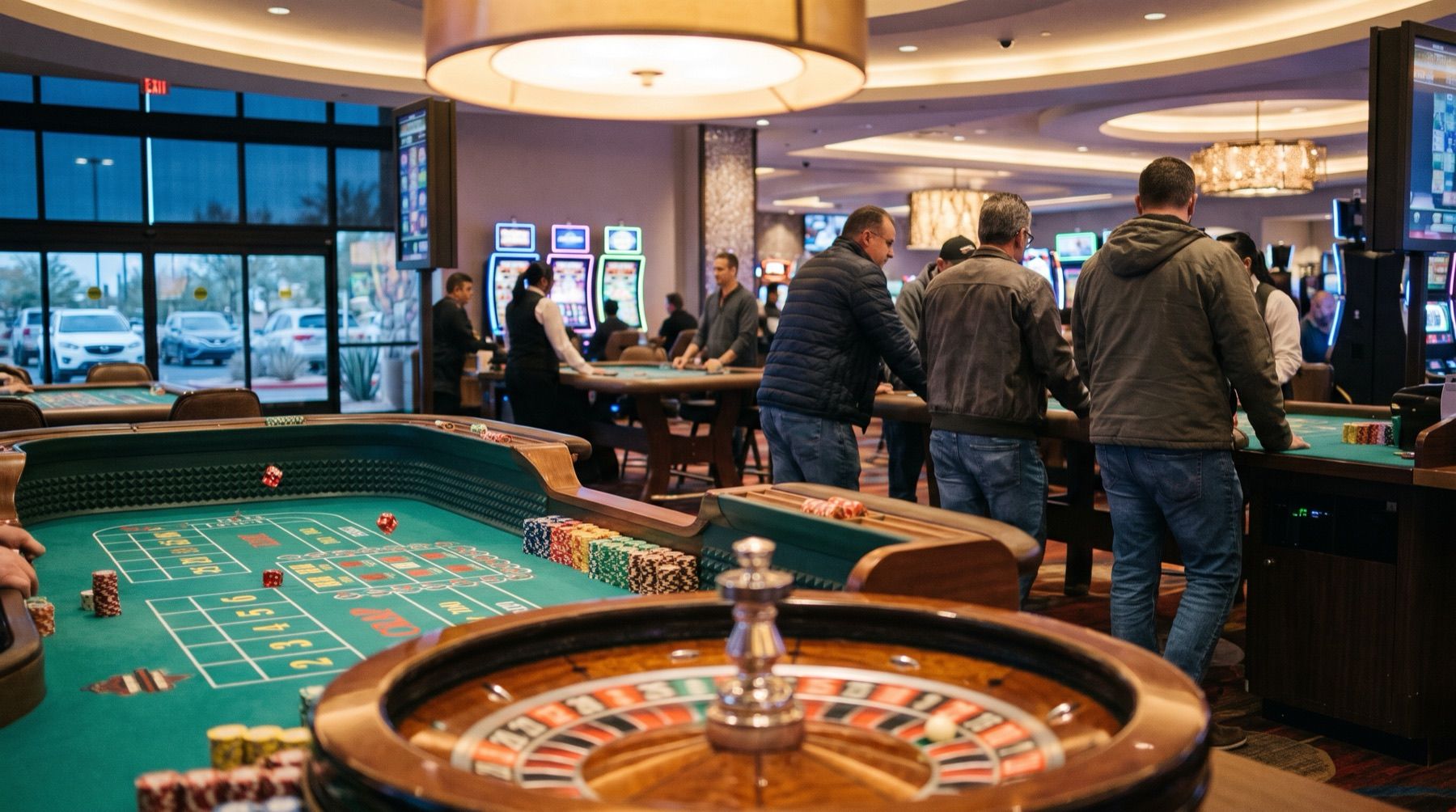
The house edge is the average share of every dollar bet that a casino keeps over millions of wagers. It is the mathematical advantage built into the rules of each game, not a guarantee for any single visit.
If you head down US-395 or cross into Douglas County to visit Reno and Lake Tahoe casinos, the house edge varies dramatically from under 1% at a standard blackjack table to over 25% in the keno lounge.
Cameras on US-395 between Reno and Carson City, the way to the south shore casinos.
House Edge Arithmetic: Table Games
The mathematical edge comes from paying winning bets at less than the true odds of the event happening.
On a standard double-zero roulette wheel, there are 38 pockets: numbers 1 through 36, a 0, and a 00. A straight-up bet on a single number pays 35 to 1. The true odds of hitting your number are 1 in 38. Because the casino pays 35 to 1 instead of 37 to 1, the house keeps 2 pockets out of 38 on average: 2 ÷ 38 = 5.26%.
A single-zero wheel features 37 pockets. With only one zero pocket providing the casino margin, the edge drops to 1 ÷ 37 = 2.70%.
Double-zero roulette also offers the five-number bet covering 0, 00, 1, 2, and 3, which carries an edge of 7.89%.
Craps edges vary on the same layout. A standard pass line bet carries a 1.41% house edge (a theoretical house advantage of 7/495). Conversely, proposition wagers in the center of the table extract far more. A one-roll any-seven bet pays 4 to 1 on an event that hits exactly 1 in 6 times, producing a 16.67% house edge.
For blackjack, playing standard basic strategy reduces the casino advantage to under 1%—falling below 0.4% under liberal rules such as standing on soft 17, offering surrender, and paying 3 to 2 on naturals. Tables that pay 6 to 5 for a blackjack instead of 3 to 2 add about 1.4 percentage points to that edge; six- and eight-deck games that hit soft 17 and pay 6 to 5 carry about 1.9%.
Video Poker and Slots: Nevada Edge and Payback
Video poker odds depend entirely on the paytable posted on the glass. A machine running full-pay 9/6 Jacks or Better (paying 9 coins for a full house and 6 coins for a flush) returns 99.54% under perfect play, which leaves a house edge of just 0.46%. You can verify paytables and exact returns using the paytable calculator before playing video poker in Nevada.
Under Nevada Gaming Commission Regulation 14.040, the statutory floor requires gaming devices to theoretically pay out at least 75% of all wagers. In practice, casinos hold far less. According to the Nevada Gaming Control Board's 12-month report ending August 31, 2026, statewide slot machines held 7.14% of coin-in. In the Reno area, slot win stood at 5.66%. On the Las Vegas Strip, slot win was 7.75%, while the South Shore Lake Tahoe corridor held 7.97%.
House Edge vs. Casino Win Percentage
The monthly Gaming Control Board reports publish a "Win Percent" for every game category across Nevada. For the 12 months ending August 31, 2026, Reno-area twenty-one tables posted an 18.97% win percentage, while statewide craps showed 16.58%.
That win percentage is not the house edge. The state calculates table-game win against the drop—the total dollar amount of cash and markers players exchange for chips at the table. Because players place chips on the layout, win some bets, and wager those same chips again and again, table drop is turned over multiple times during a single session. The house edge applies to every individual bet placed, not just the original buy-in.
Keno and slots track closer to pure house edges because players buy tickets or insert cash directly per wager. Statewide, keno win stood at 28.19% over the 12-month period, while Reno-area keno lounges retained 27.48%.
| Game | Bet / Rule | House Edge |
|---|---|---|
| Blackjack | Basic Strategy (3:2 blackjack) | < 0.40% to 1.00% |
| Video Poker | 9/6 Jacks or Better (perfect play) | 0.46% |
| Craps | Pass Line (7/495) | 1.41% |
| Blackjack | 6:5 payout, 6 or 8 decks, dealer hits soft 17 | about 1.9% |
| Roulette | Single-Zero Wheel | 2.70% |
| Roulette | Double-Zero Wheel (2/38) | 5.26% |
| Reno Area Slots | 12-Month Average (All Denominations) | 5.66% |
| Roulette | Five-Number Bet (Double-Zero) | 7.89% |
| Craps | Any Seven (One Roll) | 16.67% |
| Reno Area Keno | 12-Month Control Board Win | 27.48% |
What the Edge Means for Your Evening Budget
House edge translates into the hourly cost of an evening out: the expected loss per hour is the total you bet in that hour multiplied by the house edge. The age rule, sports betting and taxes on a win are in gambling in Nevada.
If you place $100 in total action per hour at a double-zero roulette table with an edge of 5.26%, your expected cost is $100 × 0.0526 = $5.26 an hour.
If you push $100 per hour through an active Reno slot machine operating at the local 5.66% average hold, the expected loss comes out to $5.66 per hour. Sticking to low-edge bets stretches your budget over an evening in Reno, Sparks, or Lake Tahoe, while prop bets and keno consume your bankroll rapidly. If you are heading up to the lake casinos, check US-50 road conditions for Stateline and the Mt Rose Highway for Crystal Bay before driving over a pass.