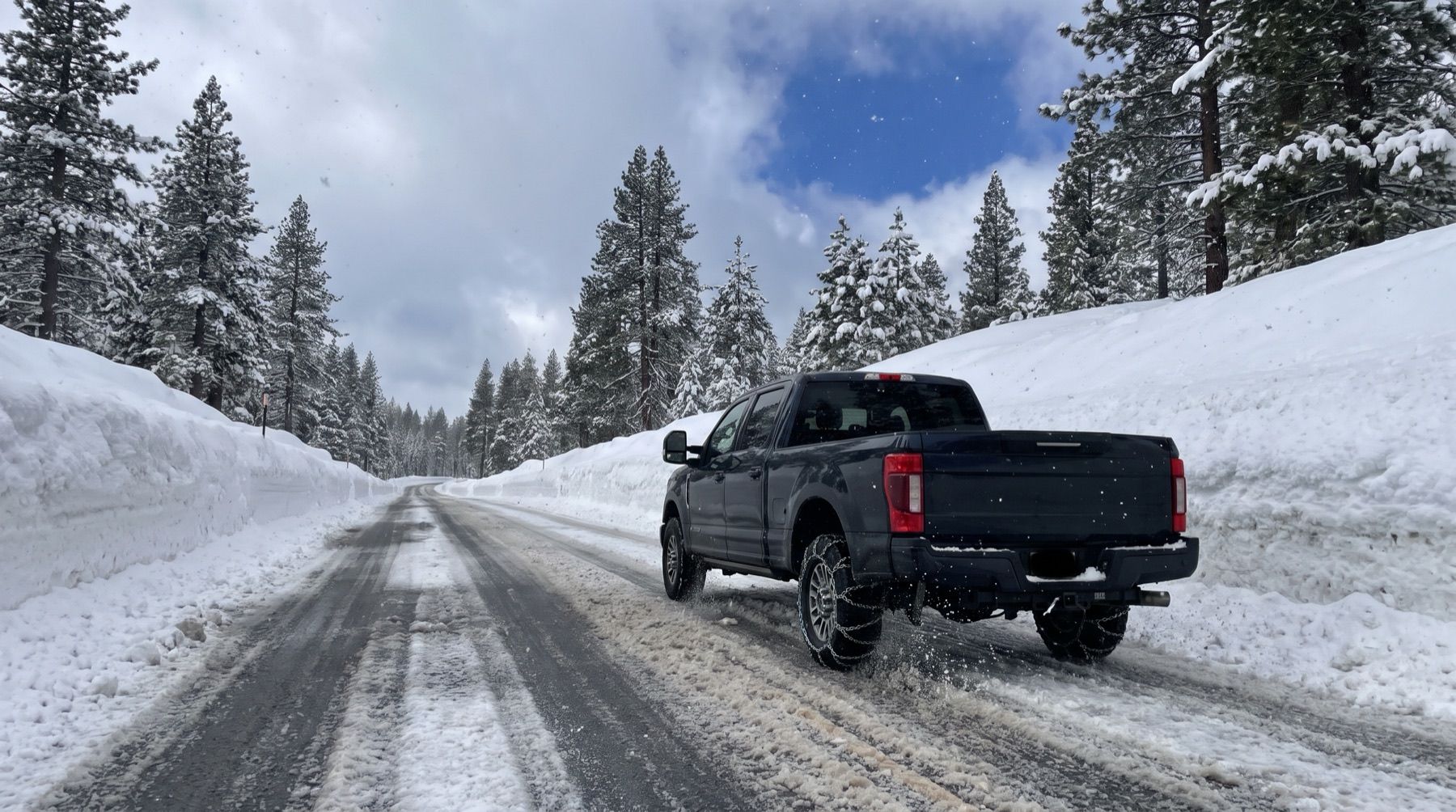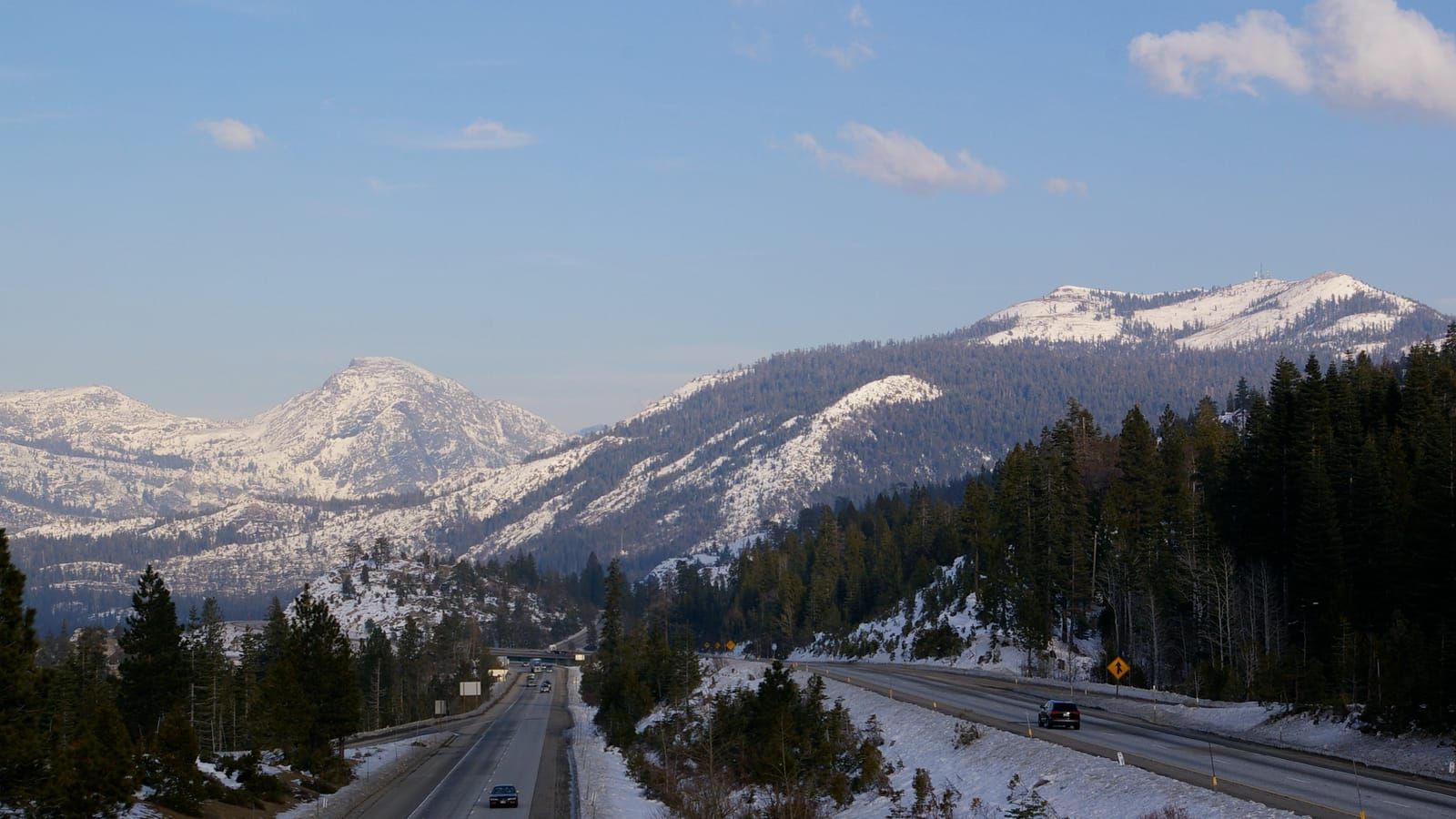
- Roadwork eastbound between Magra (Railroad) (Exit 140) and Gold Run Rd (Exit 143), traffic getting through — tree work; until 5:59 a.m.
- Roadwork eastbound between Mace Blvd (Exit 75) and County Rd 105D (Exit 78), 1 mile north of El Macero, traffic getting through — pavement work; until 4:59 a.m.
The short answer: for most cars, carry cable chains. They are legal at every California level and both Nevada levels, they fit the tight wheel wells of most modern cars, and they last on wet pavement below the snow line.
Snow socks are faster to fit and lighter, but Nevada does not promise they pass on 3 Tahoe roads. Link chains are for trucks, SUVs with room around the tire, and anyone who drives unplowed snow every week. The live line above says where controls are up now.
| Cable chains | Snow socks | Link chains | |
|---|---|---|---|
| California R-1, R-2, R-3 | Yes | Yes | Yes |
| Nevada, both levels | Yes | Yes, 10,000 lb or less | Yes |
| Mt Rose, Kingsbury, US-50 Glenbrook to Carson City | Yes | Not promised: carry chains | Yes |
| Fits low-clearance cars (SAE Class S) | Most cable sets | Yes, fabric is thin | Only sets marked Class S |
| Fitting at a chain-up area | Kneeling, hooks and a tightener | Quickest, gloves on | Slowest, kneeling |
| Wear on bare pavement | Moderate | Fast | Slowest |
| Deep, unplowed snow | Fair | Weakest | Best |
What the two states accept
All 3 count as chains in California. Caltrans's chain requirements sheet treats any device meeting Vehicle Code section 605 as chains, and names cable chains and textile socks among them. Buy one marked with its maker and country.
Nevada splits them. Cable and link chains are metal, and metal is what NAC 484D.220 calls a tire chain. That matters on Mt Rose (8,911 ft), Kingsbury and US-50 above Glenbrook, where NDOT's rule names "approved tire chains". Everywhere else in Nevada, socks pass too. The full reading is on are snow socks legal in chain controls.
Clearance decides more than the law does
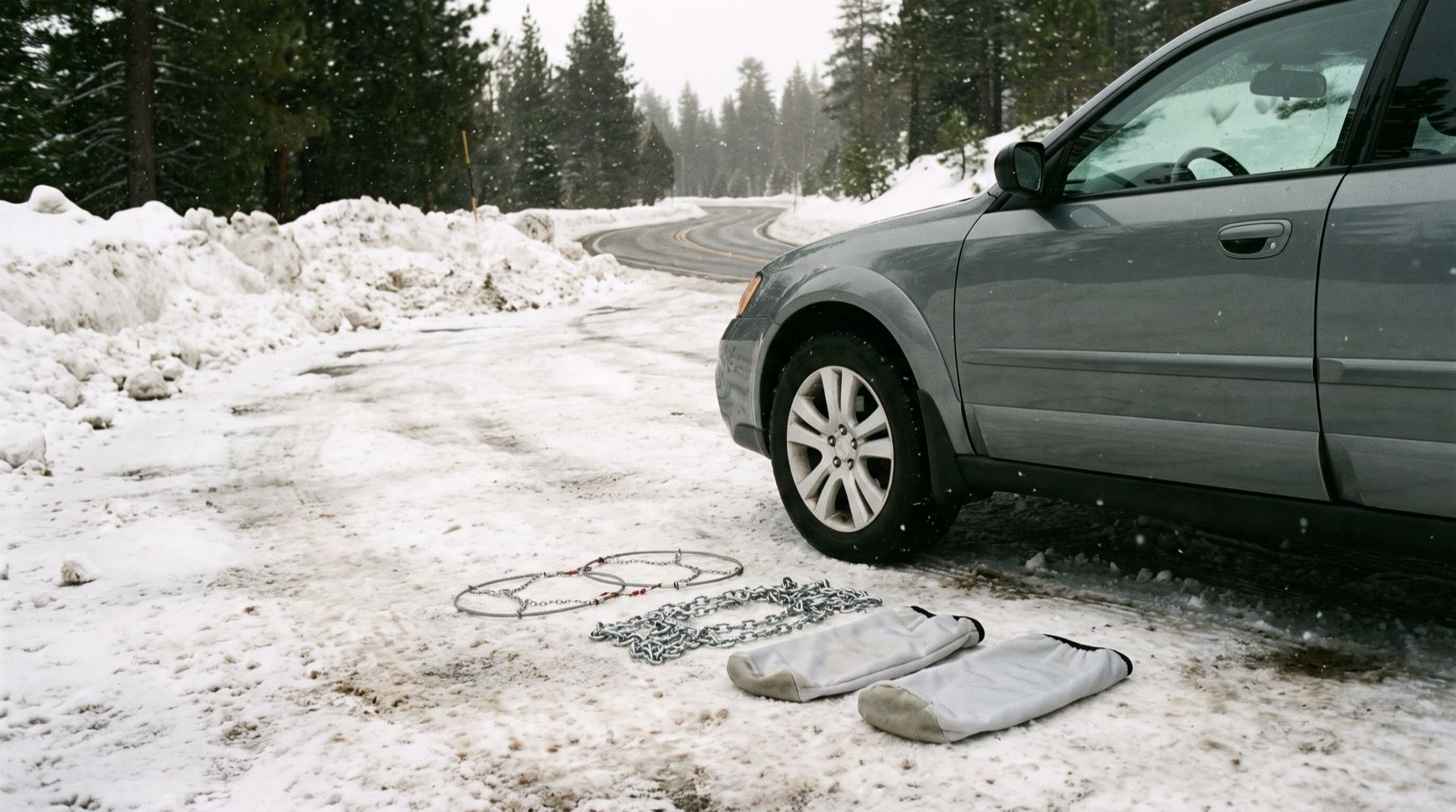
Many car owner's manuals ask for SAE Class S traction devices, or forbid chains outright, because there is little room between the tire and the suspension or brake lines. Caltrans tells drivers to check the manual before buying any device.
Cable chains are built for that gap: a steel cable with small rollers or coils, flatter than a link. SCC sells its Super Z6 for passenger cars, pickups and SUVs. Link chains come in two families. Class S passenger sets like SCC's Quik Grip Type PL fit most cars. Heavier light-truck chains need the clearance of a pickup.
Socks are the thinnest of all, which is their best argument on a sports car or an EV with big wheels.
If your manual forbids every device, the way through is the car itself. All-wheel drive on M+S tires passes R-2 untouched; at R-3 nothing passes without them, and the honest plan is to wait it out in Truckee or Meyers.
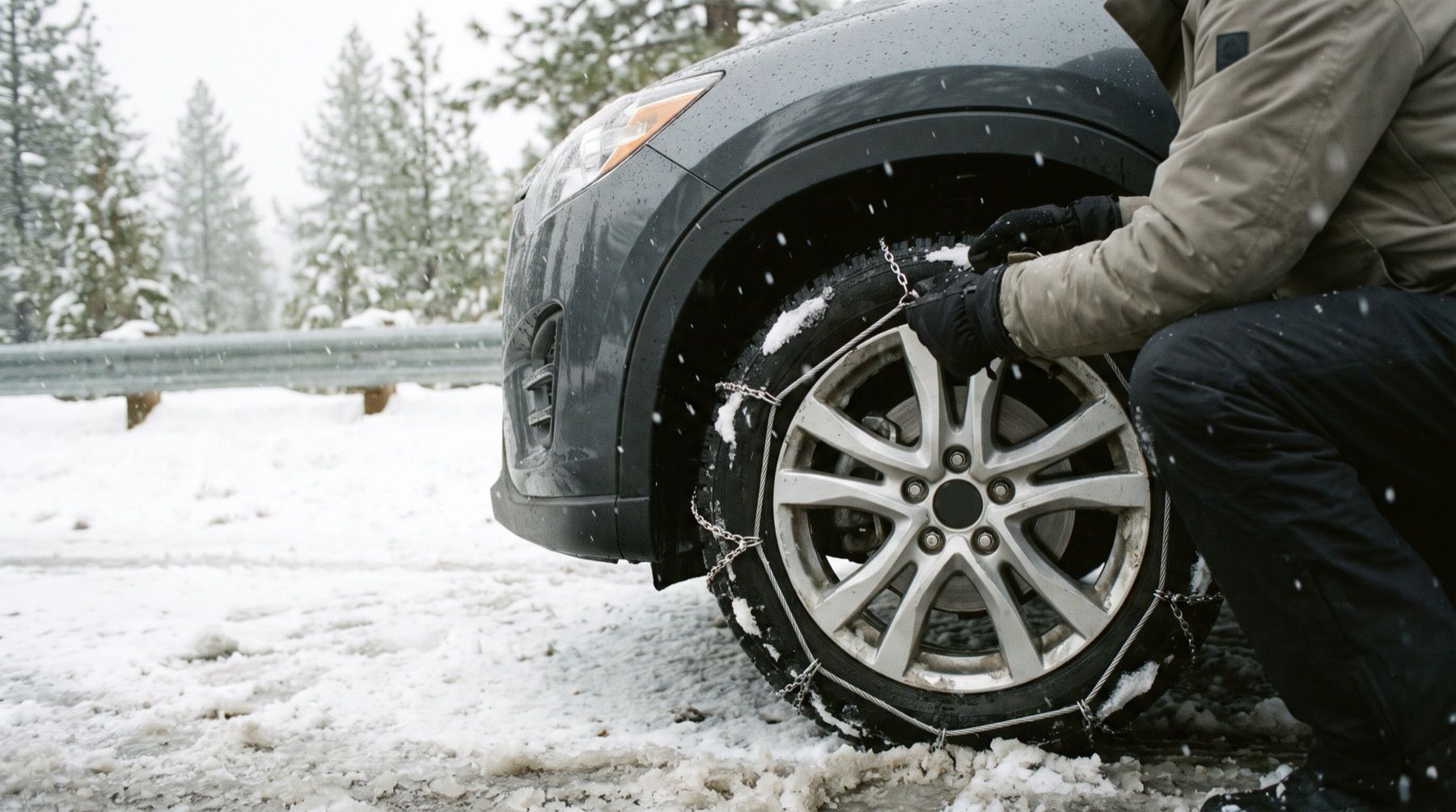
Fitting them in the slush
Fit at the chain-up area before the checkpoint, never in a traffic lane. On I-80 Caltrans most often sets the controls around Kingvale, at 6,069 ft, below Donner Summit at 7,239 ft; on US-50 it holds traffic at Echo Summit in a storm.
- Socks. Over the top half, roll forward, pull on the rest.
- Cable chains. Drape over the tire, hook the inside cable behind it, close the outside, then tension. Most sets have a built-in tightener; drive a short way, stop and tighten again.
- Self-tightening link chains such as Peerless Auto-Trac. Lay them over, join the ends behind the tire and drive forward a few feet while the ratchets pull them tight. The maker says to fit them once at home first, because tire age and tread change the fit.
- Traditional link chains. The most fiddly: lay out, hook, tension with rubber or spring tighteners, and check twice.
Speed, wear and who should not buy
Every one of them is slow. The Auto-Trac manual says never above 30 mph, and Caltrans posts 25 or 30 mph inside a control. Take any device off past the "End of Chain Control" sign, at a pull-off.
Dry asphalt below the snow line wears every device. Fabric goes first, cable lasts longer, and link chains longest, which is why heavy trucks on I-80, held to tire chains in Nevada over 10,000 lb, run links.
Who should not buy any of these?
Renters, first. Enterprise's and National's agreements ban devices unless state law requires one, so book an AWD with M+S tires instead (see car rental at Reno-Tahoe Airport). And a driver who only goes up on a dry day and turns back at R-2 needs nothing but the chain control levels and the pass cameras.