
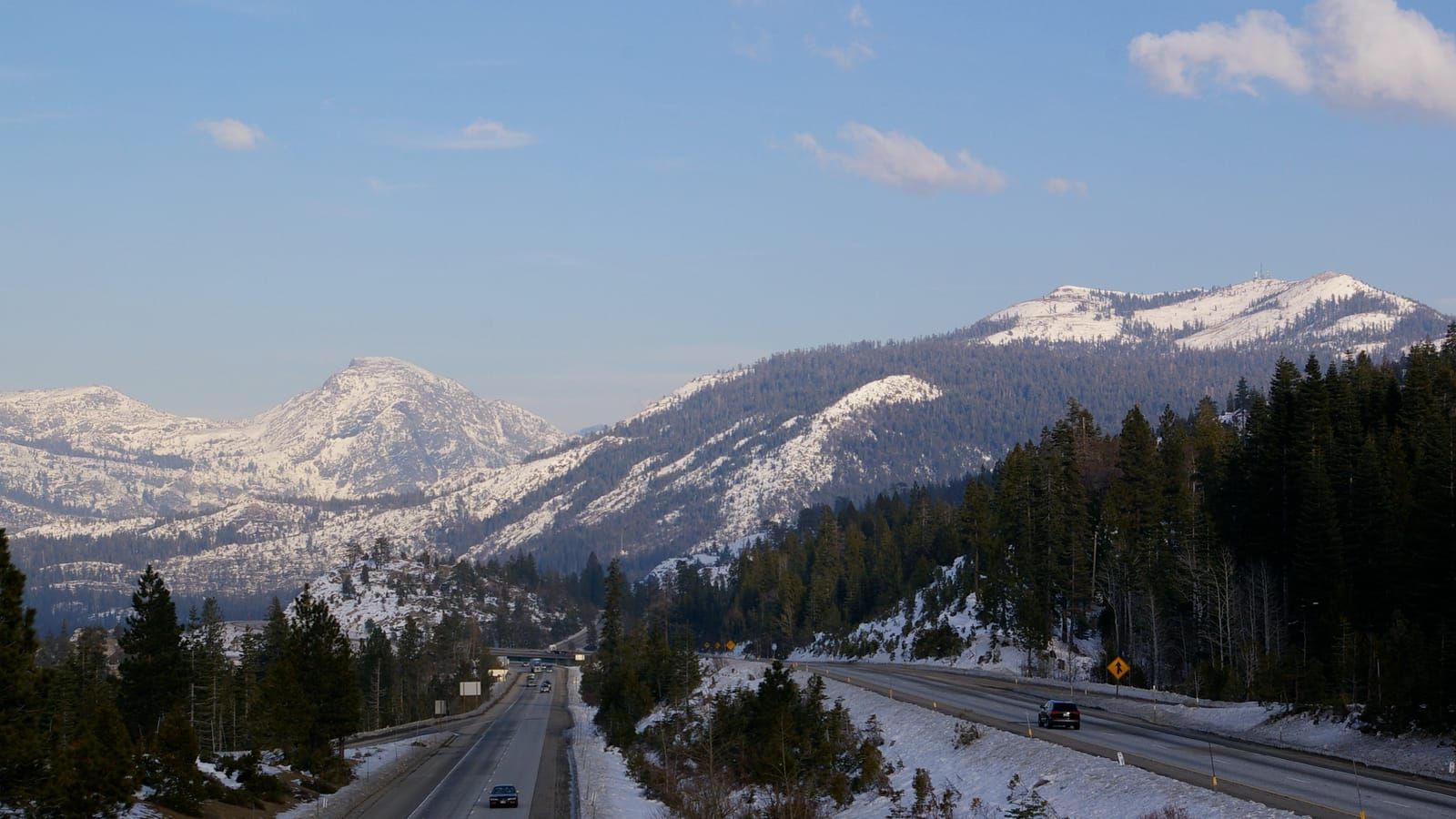
- Roadwork eastbound between Magra (Railroad) (Exit 140) and Gold Run Rd (Exit 143), traffic getting through — tree work; until 5:59 a.m.
- Roadwork eastbound between Mace Blvd (Exit 75) and County Rd 105D (Exit 78), 1 mile north of El Macero, traffic getting through — pavement work; until 4:59 a.m.
Yes in California, at all three levels. Yes in Nevada for cars and light trucks, with one exception. On Mt Rose Highway, Kingsbury Grade and US-50 between Glenbrook and Carson City, NDOT's rule names chains, and we would not count on socks there. The live line above shows where controls are up now. Everything below links to the agency's own words.
| Requirement posted | California (Caltrans) | Nevada (NDOT) |
|---|---|---|
| Chains or snow tires (R-1) | Socks count as chains | Socks approved, 10,000 lb or less |
| Chains except 4WD/AWD with snow tires (R-2) | Socks count as chains; exempt 4WD/AWD must carry some | Socks approved, 10,000 lb or less |
| Chains on every vehicle (R-3) | Socks count on paper | Nevada does not use this level |
| SR-431, SR-207, US-50 Glenbrook to Carson City | Not California | Rule says "approved tire chains": carry real chains |
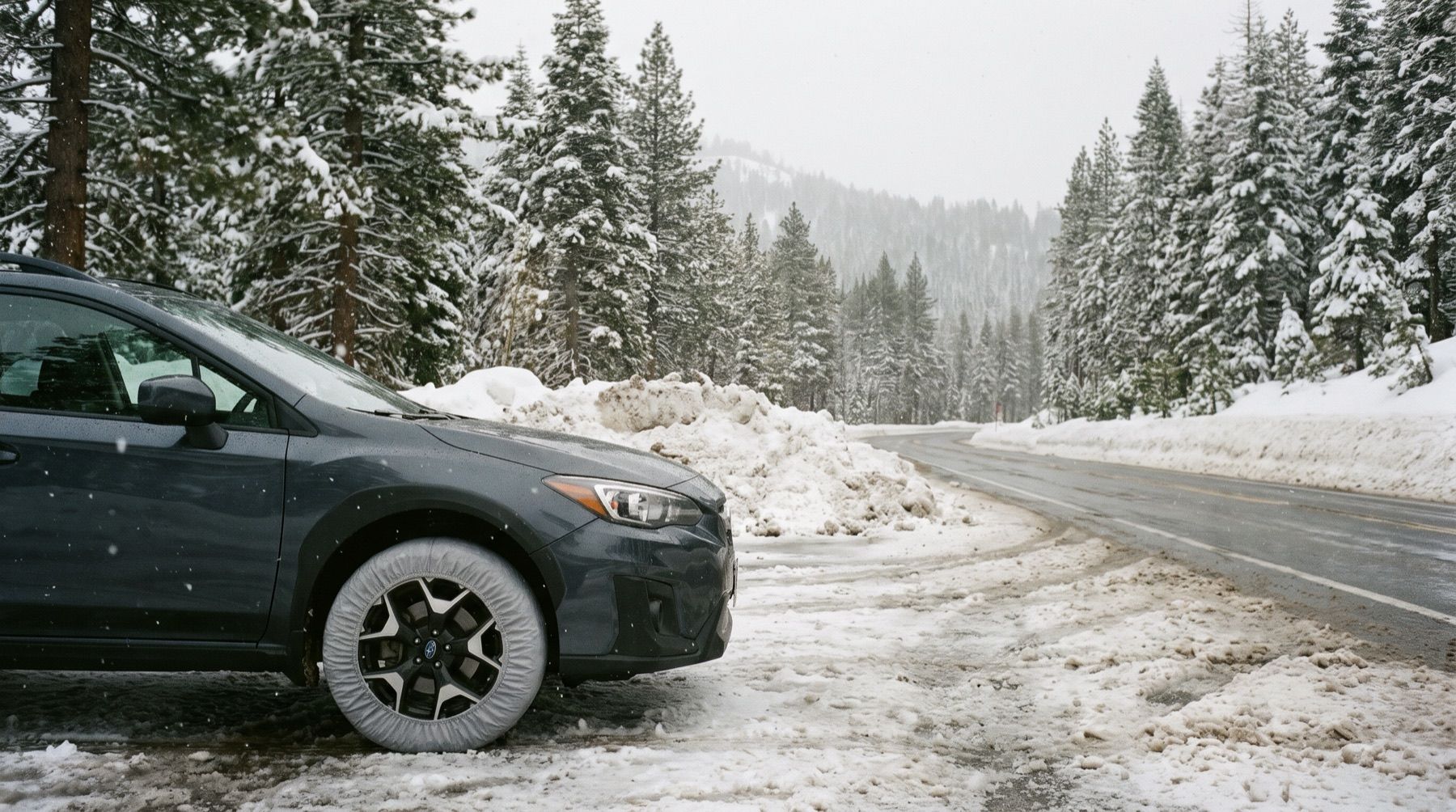
California: socks count as chains at every level
The Caltrans chain requirements sheet, revised in October 2016, lets vehicles into a chain control area with link chains or "Alternative Traction Devices". Its examples are cable chains, textile snow chains, wheel-hub chains and automatic chains. It also says that wherever it writes "chains", it means any tire traction device that meets California Vehicle Code section 605.
Section 605 asks three things. The device improves traction, braking and cornering on snow or ice. It is built so it will not come off. And it carries a permanent mark with the maker's name or trademark and the country it was made in.
Caltrans and the CHP keep the right to turn back a car whose devices fail section 605, so buy a branded sock with that mark on it.
What that means at each level, from the Caltrans chain controls page:
- R-1. Cars and light trucks under 6,000 lb with snow tires on at least 2 drive wheels drive through, but must carry chains. A pair of socks in the trunk is that. Every other vehicle fits them on the drive axle.
- R-2. Four-wheel and all-wheel drive with snow-tread tires on all 4 wheels drive through, but must carry traction devices. Socks qualify. Everything else fits them.
- R-3. Every vehicle fits chains or traction devices, and socks count. But R-3 is the deepest, least-plowed snow, exactly where socks are weakest, and the sheet warns that less conventional devices "may be restricted at times due to local conditions".
Nevada: approved, except on three Tahoe roads
NRS 484D.520 lets a vehicle of 10,000 lb or less meet a posted requirement with traction devices, tire chains or snow tires. Above 10,000 lb, counting a trailer, it has to be tire chains. When NDOT posts chains on everything except 4WD with snow tires, the same section still allows traction devices.
NDOT's traction page says Nevada has approved alternative traction devices made of fabric or plastic. They wrap the whole tread, fasten on both sides of the wheel and carry the maker's name and country. So on I-80 through Reno and on US-395, socks are legal at both of NDOT's levels. NDOT's own table says Nevada does not use a third, chains-on-everything level.
The exception is SR-431 over Mt Rose, SR-207 over Kingsbury Grade and US-50 from Glenbrook to Carson City. There, when a chain requirement is up, NDOT lets through only 4WD or AWD with snow tires and "vehicles with approved tire chains". NDOT does not say whether a sock counts as a tire chain, and NAC 484D.220 describes tire chains as metal or plastic.
So we will not tell you socks pass there. In a two-wheel-drive car, carry metal or cable chains for Mt Rose Summit (8,887 ft), Daggett Summit on Kingsbury (7,338 ft) and Spooner Summit (7,156 ft). The live answers are on Mt Rose Highway conditions and Kingsbury Grade conditions.
What it means for 4WD and AWD
With M+S tires on all 4 wheels, a 4WD or AWD vehicle drives through California R-1 and R-2 and both Nevada levels without fitting anything. In California it must still carry traction devices. That is the strongest case for socks: they are the lightest, flattest way to meet the carry rule all winter.
At California R-3 a 4WD or AWD fits chains or socks like any other car. On tires without the M+S mark, the exemption does not apply at R-2 either. Which axle gets them is in your owner's manual. Caltrans puts them on the drive axle, the front one on a front-wheel-drive car, and Nevada's NRS 484D.525 asks for at least 2 driving wheels.
Why socks, and who should carry them
There are no hooks, tensioners or cross-links to lay out in the slush. You pull the sock over the top half of the tire, roll forward far enough to bring the bottom into reach, and pull on the rest. It centers itself as you drive off, and all of it can be done with gloves on.
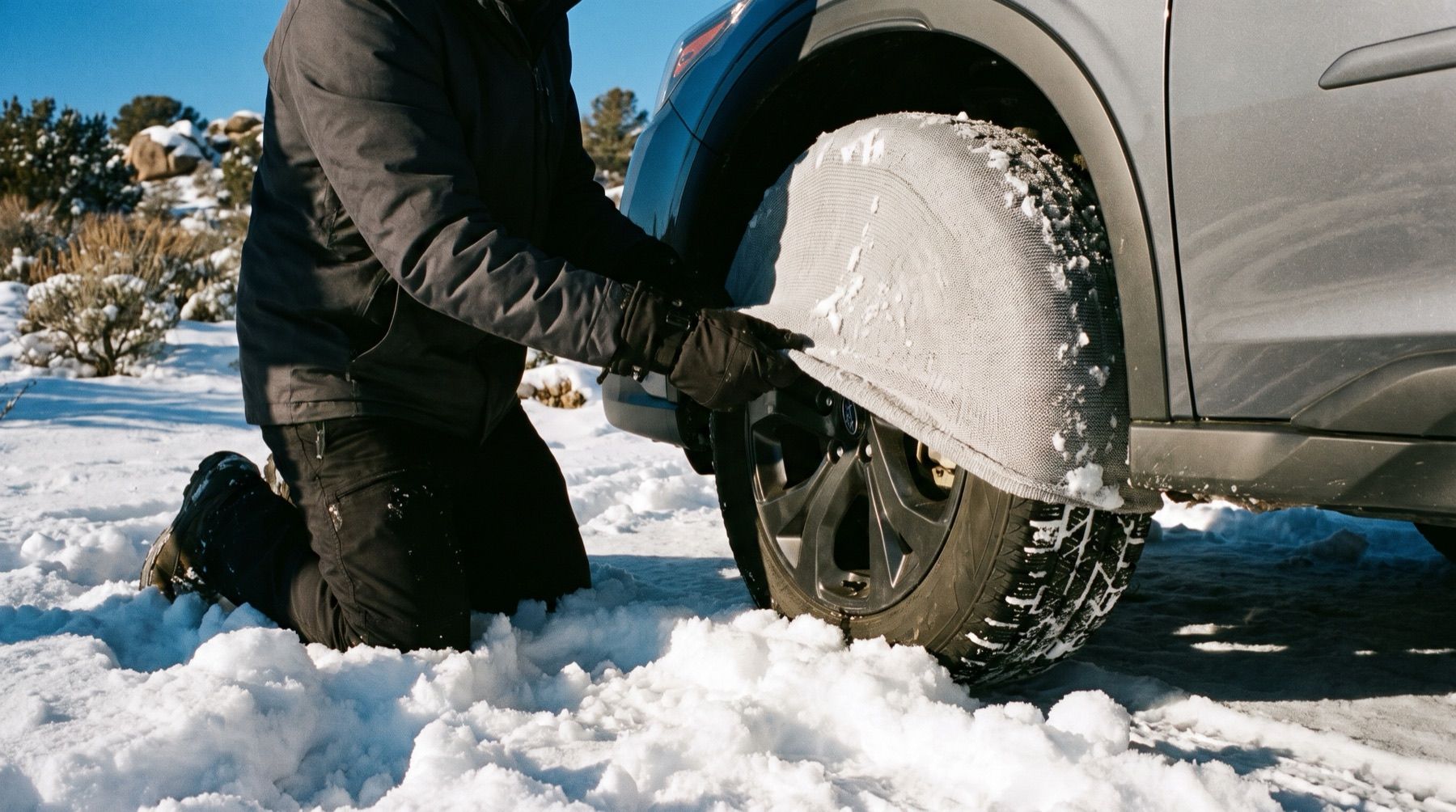
The person who runs this site carries a pair through the winter for those reasons. They fit easily in the cold, they weigh little, and they live in the trunk without taking it over. They also suit cars whose owner's manual limits what fits around the tire, because fabric is thin. Check the manual first, which is Caltrans's advice for any traction device.
When chains or cables are the better buy
Speed is the first limit. AutoSock rates its car socks at 30 mph at most and calls that a maximum, not a target. Caltrans's chain-control speed limit is 25 or 30 mph, so inside a control you are already at the sock's limit. Outside one, they come off.
Bare pavement is the second, and it is how socks die. Caltrans's 2019 research summary notes that its inspection sites sit well below the snow line, which leaves a few to several miles of wet road on the device. AutoSock's driving notes say clear roads wear them fastest. Replace them once 50% of the white road-contact fabric is gone.
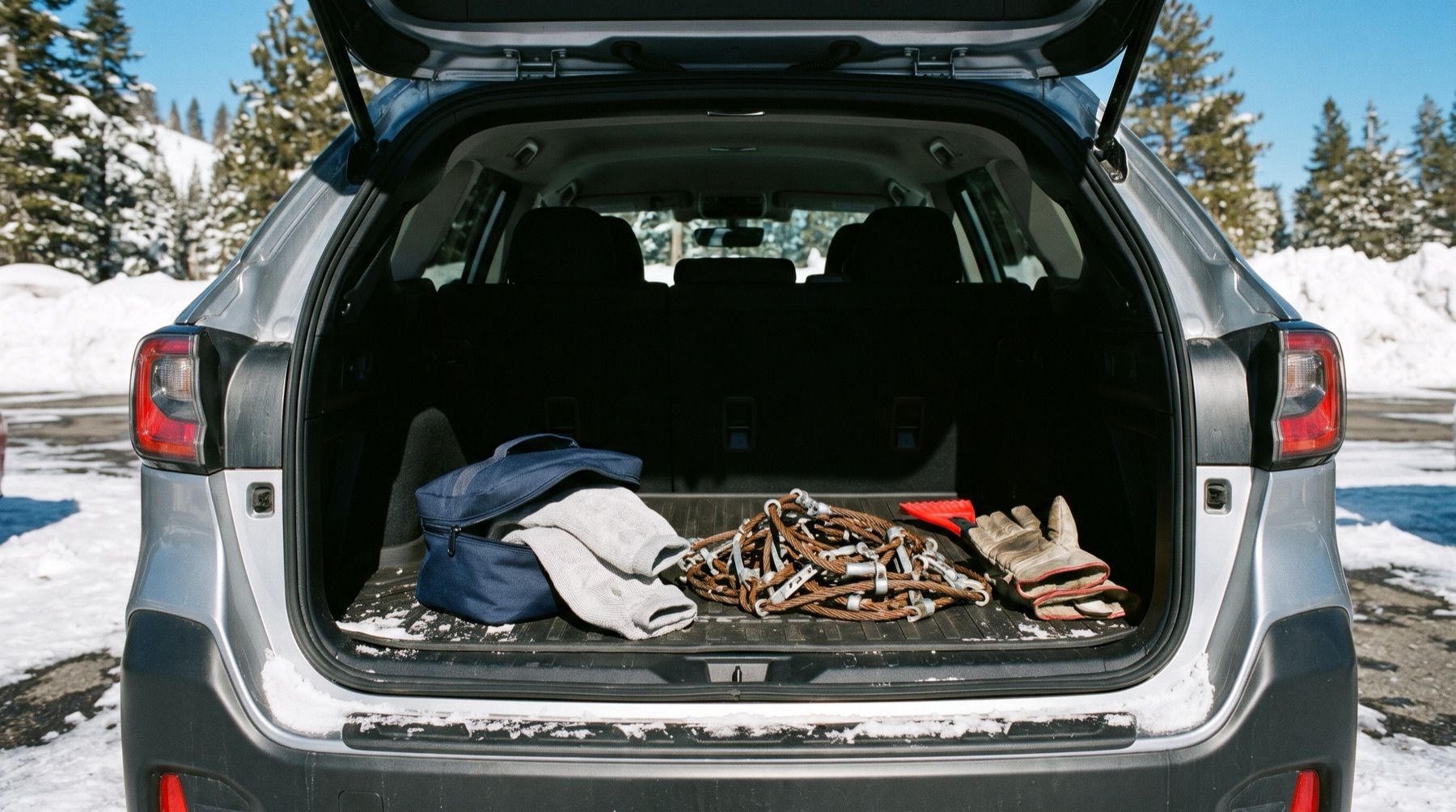
Then there is the snow itself. On a slushy climb a sock can grip the snow while the snow gives way under the car, and spinning the wheels shreds the fabric. Chains bite through.
If you cross Donner or Echo Summit, 7,427 ft, every week, or drive unplowed roads to a cabin, buy chains. Cable or link, compared for clearance and fitting: cable chains, snow socks or link chains. Heavy trucks and towing rigs over 10,000 lb need chains in Nevada in any case.
Using them at a chain control
Fit them at the chain-up area before the checkpoint, never in a traffic lane. Take them off past the "End of Chain Control" sign at a pull-off, and never leave them on overnight, when they can freeze to the ground. Practice once in the driveway in October.
The full packing list is on what to carry for Sierra winter driving, and the levels for trucks and trailers are on chain control levels R1, R2 and R3 explained.
Before you leave, check the summit cameras on the pass cameras page and the live answer for Donner Pass chain controls. Then confirm with Caltrans or NDOT, whose signs are the law on the day.